

A reverse proxy server is a type of proxy server that typically sits on or behind the firewall in a private network and manages client requests to the appropriate origin server.
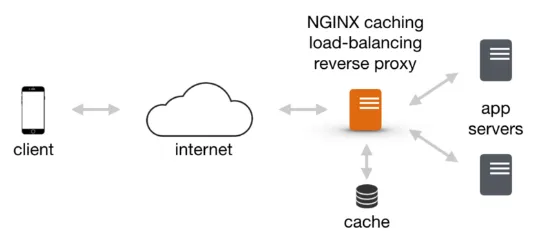
Common uses for NGINX include:
- SSL Termination – Secure traffic between clients and your server by relieving your upstream web and application servers of the computational load of SSL/TLS encryption.
- Web acceleration – Reverse proxies can compress inbound and outbound data, as well as cache commonly requested content, both of which speed up the flow of traffic between clients and servers. Offloading SSL encryption also significantly boosts application performance.
- Load balancing – A reverse proxy server can act as a “traffic cop,” sitting in front of your backend servers and distributing client requests across a group of servers in a manner that maximizes speed and capacity utilization while ensuring no one server is overloaded, which can degrade performance. If a server goes down, the load balancer redirects traffic to the remaining online servers.
- Security and anonymity – By intercepting requests headed for your backend servers, a reverse proxy server protects their identities and acts as an additional defense against security attacks. It also ensures that multiple servers can be accessed from a single record locator or URL regardless of the structure of your local area network.
The NGINX family of reverse proxies are the best-in-class load‑balancing solutions used by high‑traffic websites such as Dropbox, Netflix, and Zynga. More than 350 million websites worldwide rely on NGINX Plus and NGINX Open Source to deliver their content quickly, reliably, and securely.
As a software‑based reverse proxy, not only is NGINX less expensive than hardware‑based solutions with similar capabilities, it can be deployed in the public cloud as well as in private data centers, whereas cloud infrastructure vendors generally do not allow customer or proprietary hardware reverse proxies in their data centers. Even in your own premises, virtualization saves you space as well as reduces your electrical bill.
Lightspeed frequently virtualizes NGINX and deploys it as a container into Edge servers for line of business applications. We also use NGINX to dramatically improve both speed and security of PHP and Java based applications by providing SSL Termination and caching of static content.